

By reading this article and continuing to use this website, you acknowledge and agree to our Disclaimer and Terms. Nothing on this site constitutes investment advice. Investing involves risk, including possible loss of principal.
This is the second of our new-and-improved earnings previews that will contain working three statement financial models for your download, complete with forward forecasting and user ability to toggle. Would love to hear your feedback.
Hims & Hers Estimates + Financial Model
Below please see all of the important metrics for HIMS for the quarter and for forward guidance, along with how estimates have shifted intra-quarter (75D Est. Drift column). All of this is also available on a tab in the full three statement financial model attached below the table.
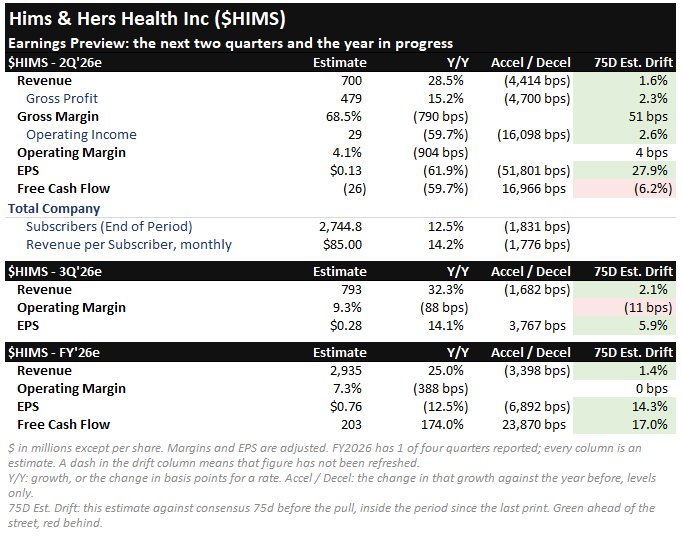
Here is the full financial model - feel free to play around with any and all assumptions, the model will update itself in response.

Valuation Context + Bull / Bear Theses
DIRECTIONAL COMMENTARY
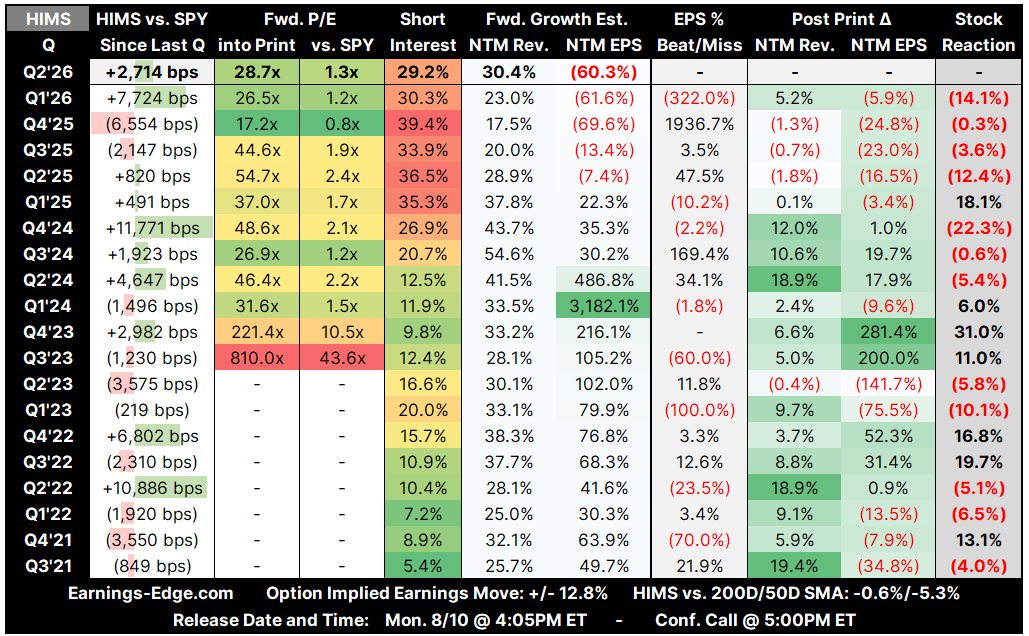
HIMS enters the print having outperformed SPY by 2,714 bps since the last report, the fifth largest three month outperformance in the entire table, and the forward P/E has re-rated from 17.2x at Q4’25 to 26.5x at Q1’26 to 28.7x now, a 1.3x premium to SPY versus 0.8x two quarters ago. The forward growth mix is the problem: NTM revenue growth of 30.4% is up from 23.0%, but NTM EPS growth sits at negative 60.3%, a second straight quarter near that level, and the post-print NTM EPS revision has been negative in each of the last five reported quarters, including negative 24.8% at Q4’25 and negative 23.0% at Q3’25. The reaction history is the decisive input, because beats simply are not paid here: Q4’25 at 17.2x posted a 1,936.7% beat for a negative 0.3% move, Q3’25 at 44.6x posted a 3.5% beat for negative 3.6%, Q2’25 at 54.7x posted a 47.5% beat for negative 12.4%, and Q1’26 at 26.5x posted a 322.0% miss for negative 14.1%. Only one of the last eight prints, Q1’25 at 37.0x, closed higher, and that came off a miss. Short interest of 29.2% is the highest of any name in this table and is genuine squeeze fuel against a 12.8% options implied move that realized outcomes of 14.1%, 12.4%, 18.1% and 22.3% have repeatedly exceeded. Re-rated hard into the event, deteriorating on forward EPS, and with a reaction pattern that punishes good numbers: SHORT, small size, with the 29.2% short interest and the wide implied move capping conviction.
This is investment analysis, not advice. Do your own due diligence. Please note that we provide commentary on the setup without a deep fundamental edge.
Bull Bullets: Branded GLP-1 relaunch, international footprint, and 2030 targets drive re-acceleration
• Second quarter guidance of $680 million to $700 million implies 25% to 28% growth against the 4% posted in Q1, and the branded Wegovy and Ozempic assortment is now fully live on the platform following the March agreement with Novo Nordisk. A reaffirmation or raise of the $2.8 billion to $3.0 billion full year range would establish that the compounded-to-branded transition is behind the company rather than ahead of it.
• The Eucalyptus acquisition closed in June, adding the Juniper brand and a Japanese market entry on top of the ZAVA footprint in Europe and the planned Canadian launch. Non-weight-loss specialties spanning menopause, testosterone, dermatology and mental health are the mechanism by which management intends to dilute the GLP-1 concentration that has driven the volatility, and evidence of that mix shift is the single most valuable disclosure in this report.
• Forward EBITDA is the swing factor for sentiment, and guidance of $35 million to $55 million for the quarter would represent the first clean read on whether branded economics can support the margin structure. Delivery inside that range while holding the 2030 framework of at least $6.5 billion of revenue and $1.3 billion of adjusted EBITDA would give the market a reason to underwrite the model again after two quarters of estimate cuts.
Bear Bullets: FTC litigation, branded margin dilution, and supplier dependence pressure the model
• The suit brought in late July by the Federal Trade Commission alongside Utah and Los Angeles County targets subscription cancellation practices and the sharing of health information with advertising platforms, aiming squarely at the direct-to-consumer acquisition engine. A consent decree or adverse ruling that forces changes to signup and retention flows would structurally raise customer acquisition cost and slow the subscriber additions the guidance depends on.
• Distributing branded semaglutide at pricing consistent with other telehealth platforms removes the cost advantage that built the weight loss book and transfers economics back to the manufacturer. Novo Nordisk has already terminated a collaboration once and simultaneously sells through competing channels, leaving Hims dependent on a supplier whose incentives are not aligned with platform margin expansion.
• Full year guidance embeds a steep second half re-acceleration against a first quarter that grew 4%, and consensus has moved to a loss for 2026 from a prior profit expectation. The departure of the chief accounting officer announced in July adds an unwelcome question mark heading into a print where reported margin quality, not revenue, is the central debate.
Key Investment Thesis
Hims & Hers Health is a direct-to-consumer telehealth platform that connects patients with licensed providers and fulfills personalized prescription treatments across weight loss, sexual health, dermatology, mental health and hair care on a recurring subscription basis.
Upside Case: The branded GLP-1 relaunch restores sequential subscriber growth while the Eucalyptus, ZAVA and Canadian expansions add geographies that are not exposed to United States compounding regulation. If specialty categories scale toward the stated 2030 framework and EBITDA margin holds in the low double digits through the transition, the market re-underwrites a durable subscription compounder rather than a GLP-1 trade.
Downside Case: The FTC action forces changes to subscription mechanics that raise acquisition costs just as branded product economics compress gross margin, leaving the company growing revenue without converting it to profit. Continued negative forward EPS revisions against a premium multiple would leave the equity carrying growth-stock valuation on a business with deteriorating unit economics and unresolved regulatory overhang.
Differentiation: Vertical integration across proprietary electronic medical records, affiliated pharmacies and an owned brand portfolio gives Hims control of the patient relationship and pricing in a way pure marketplaces and traditional pharmacy channels cannot replicate. Few peers combine that infrastructure with a consumer brand capable of acquiring patients at scale outside insurance.