

Musk wants SpaceX and Tesla under one roof. Run it through Consensus and the arithmetic works for exactly one side.
On Tuesday’s SpaceX earnings call Elon Musk confirmed what the market had been trading for a fortnight. SpaceX and Tesla have each formed a special committee of independent directors to look at a merger. He thinks it is “a good idea.” He cannot sit in the room because he is conflicted. Nothing is agreed, and he went out of his way to say a deal is not certain.
He also said the thing that matters most and got the least attention: Tesla would need a majority of all shares outstanding, not a majority of the votes cast. Every ballot that never comes back counts as a no.
Wall Street has already decided how it would go. Barclays expects SpaceX to acquire Tesla in a stock-for-stock exchange. RBC and JPMorgan think Tesla holders would want a 20% to 35% premium. Dan Ives has $500 to $550 a share in mind. Others expect no premium at all, on the argument that the two shareholder registers overlap so heavily that nobody is really paying anybody.
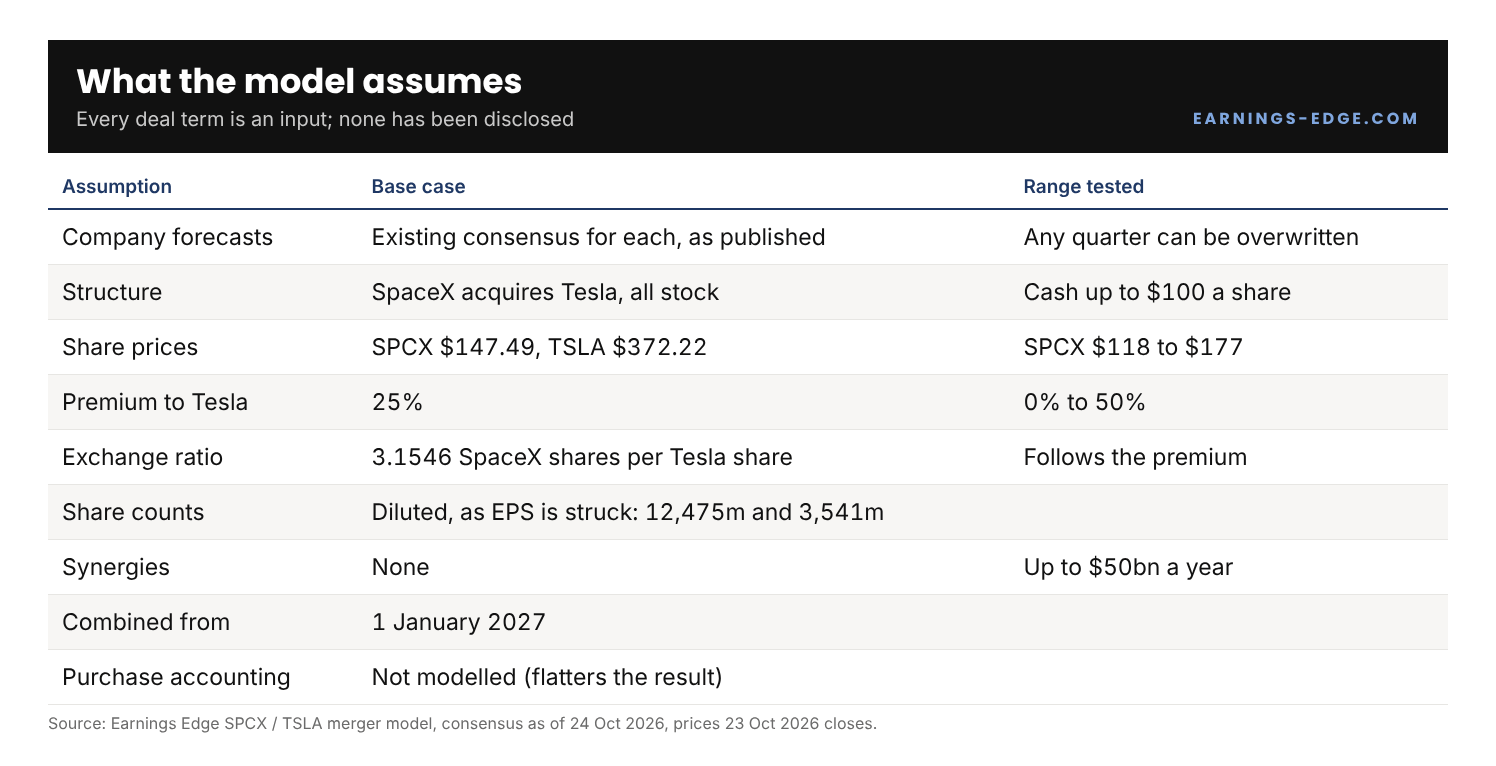
So I built the deal the way the sell side describes it and let the numbers talk. The starting point for each company is existing street consensus, quarter by quarter through 2028, exactly as published. I have not substituted my own forecasts for either business. Everything the model adds on top (the premium, the exchange ratio, synergies, financing) is an input you can change, and the conclusion barely moves when you do.
The short version
What it finds:
The deal is 39% dilutive to SpaceX’s 2027 earnings per share at a 25% premium, and 33% dilutive at no premium at all.
Breaking even needs about $70 billion a year of synergies. Tesla’s entire 2027 consensus EBITDA is $18 billion.
Tesla would bring 11% of the combined earnings and own 47% of the company. A Tesla holder’s look-through earnings per share roughly quadruple.
Tesla’s cash helps SpaceX’s spending, but it covers about three weeks of SpaceX’s 2027 capex.
Musk keeps control either way. On the stated share classes he ends near 32% of the economics and 73% of the votes.
The deal, priced
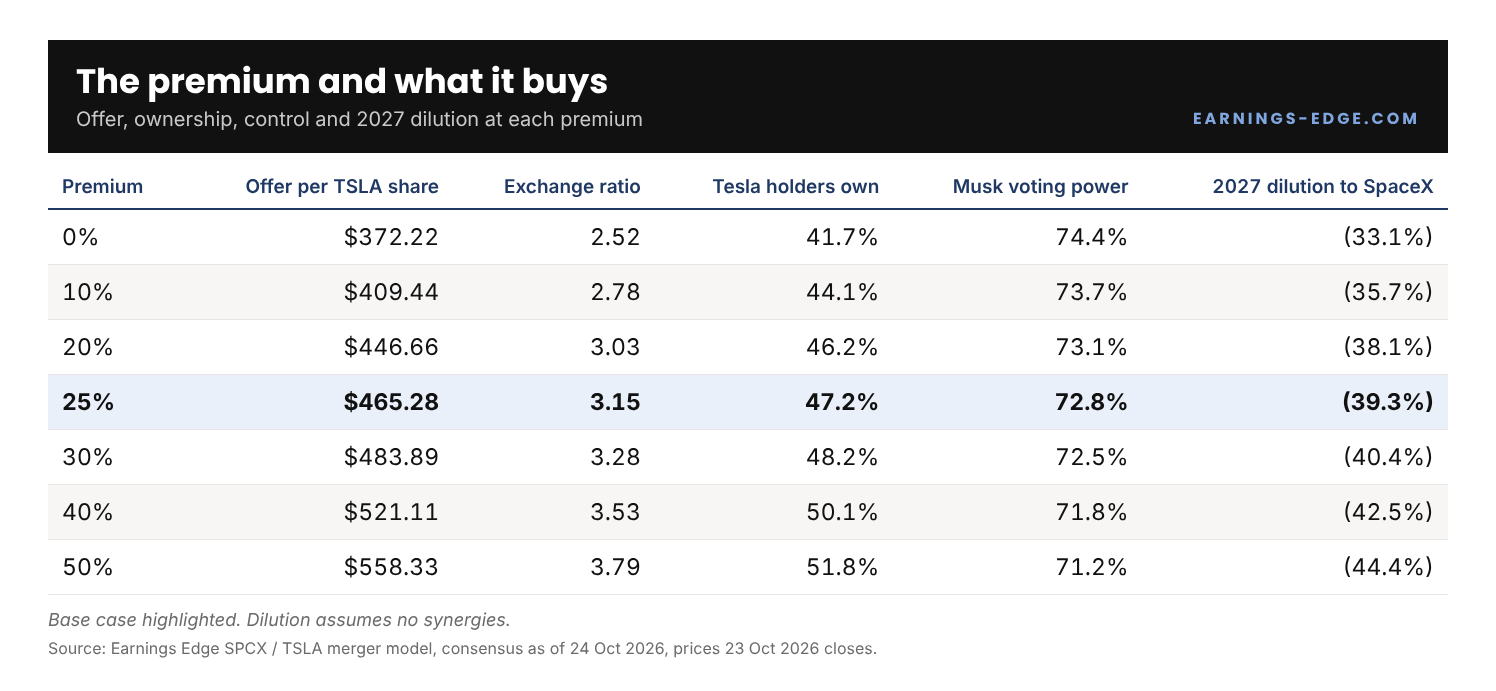
At a 25% premium Tesla holders get $465.28 a share, paid as 3.1546 SpaceX shares. Across 3.54 billion Tesla shares that is $1.65 trillion of equity, or $1.61 trillion of enterprise value once you take off Tesla’s $36 billion of net cash. SpaceX issues 11.2 billion new shares and former Tesla holders end up owning 47.2% of the combined company.
A note on the market caps, because they will not match what you have read. The press quotes SpaceX near $2 trillion and Tesla near $1.5 trillion, using shares-outstanding figures of 13.6 billion and 3.95 billion. The earnings per share both companies report are struck on smaller diluted weighted counts, so that is what the accretion math has to use. On those counts the two are worth $1.84 trillion and $1.32 trillion.
The premium moves ownership less than you might expect. Ives’ $500 to $550 range is a 34% to 48% premium, which would hand former Tesla holders roughly half the company.
The multiples do all the work
Here is the whole argument in one table.
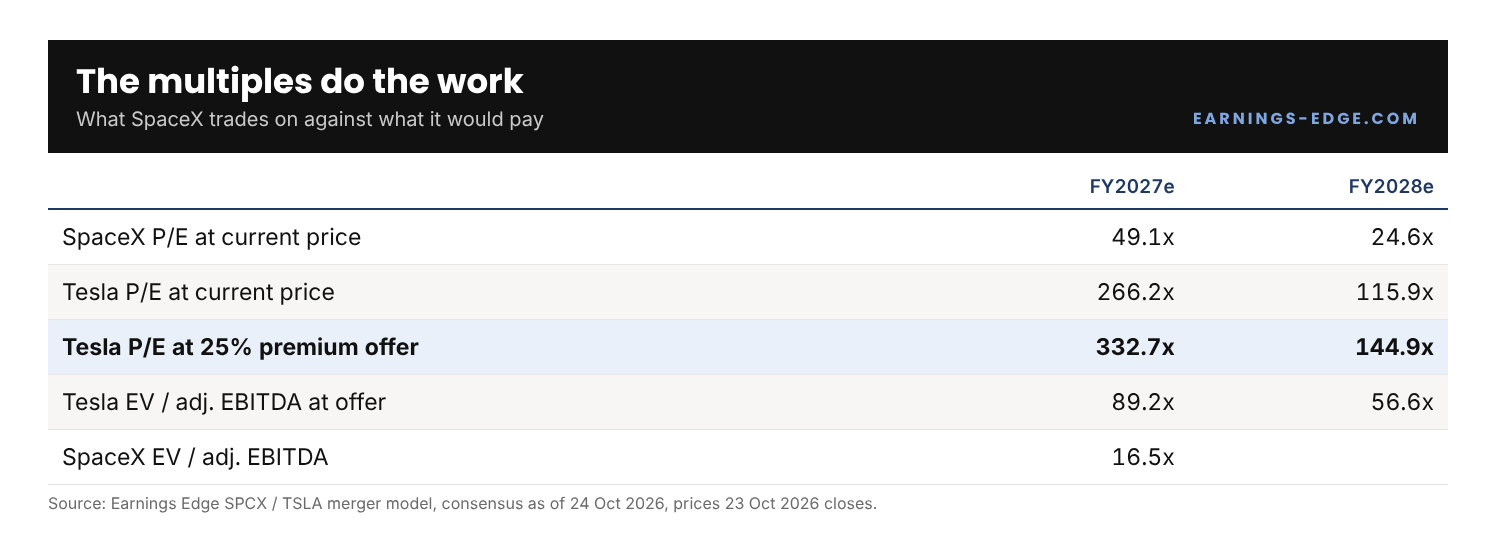
SpaceX would be paying 333 times next year’s earnings, in its own stock, for a company priced at nearly seven times SpaceX’s own multiple. An acquirer cannot do that and keep its earnings per share intact. The size of the premium is close to beside the point.
Accretion and dilution
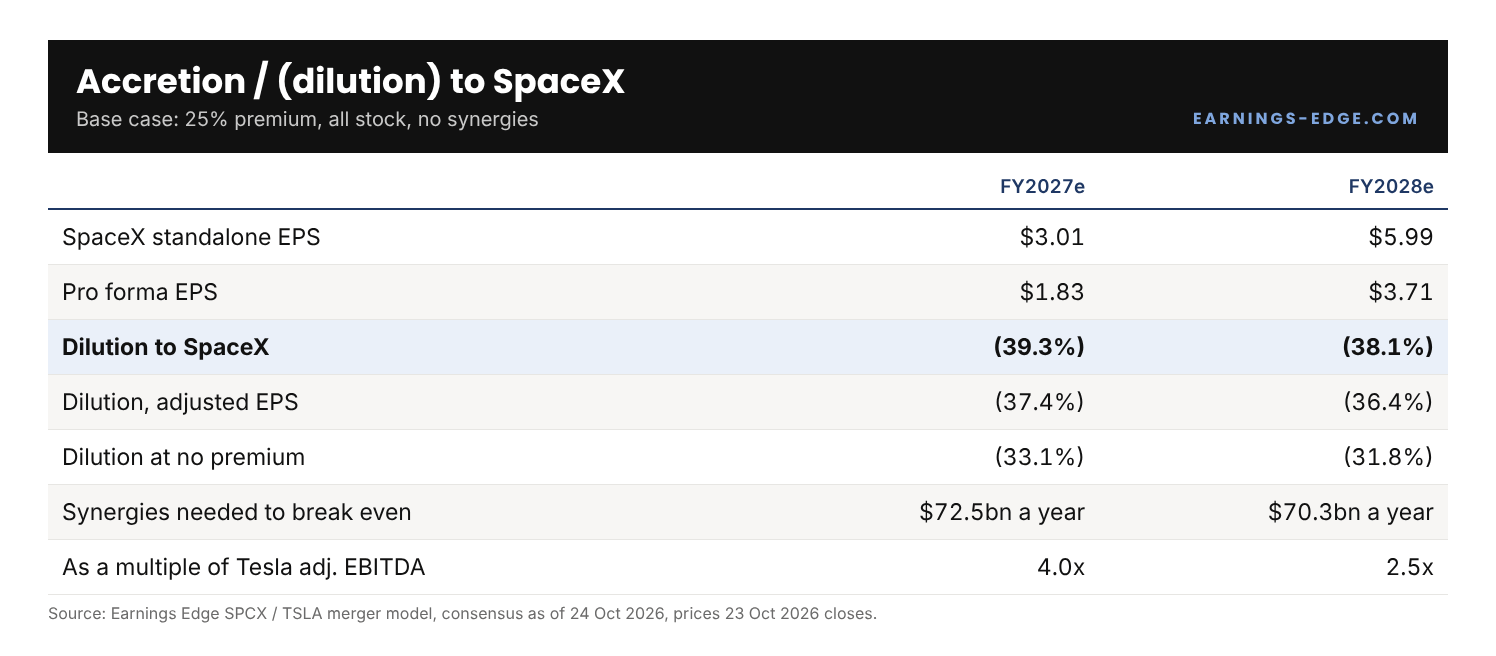
Two things stand out. The dilution does not close between 2027 and 2028, even though SpaceX’s own earnings are expected to double; Tesla’s grow too, and the gap in multiples persists. And the breakeven synergy number is not a stretch target. It is four times Tesla’s EBITDA.
The rest of this piece covers whether any synergy figure can rescue the deal, why it looks completely different from the Tesla side, the cash, the control math, and where I come out. Paid subscribers also get the full model, with every assumption adjustable.